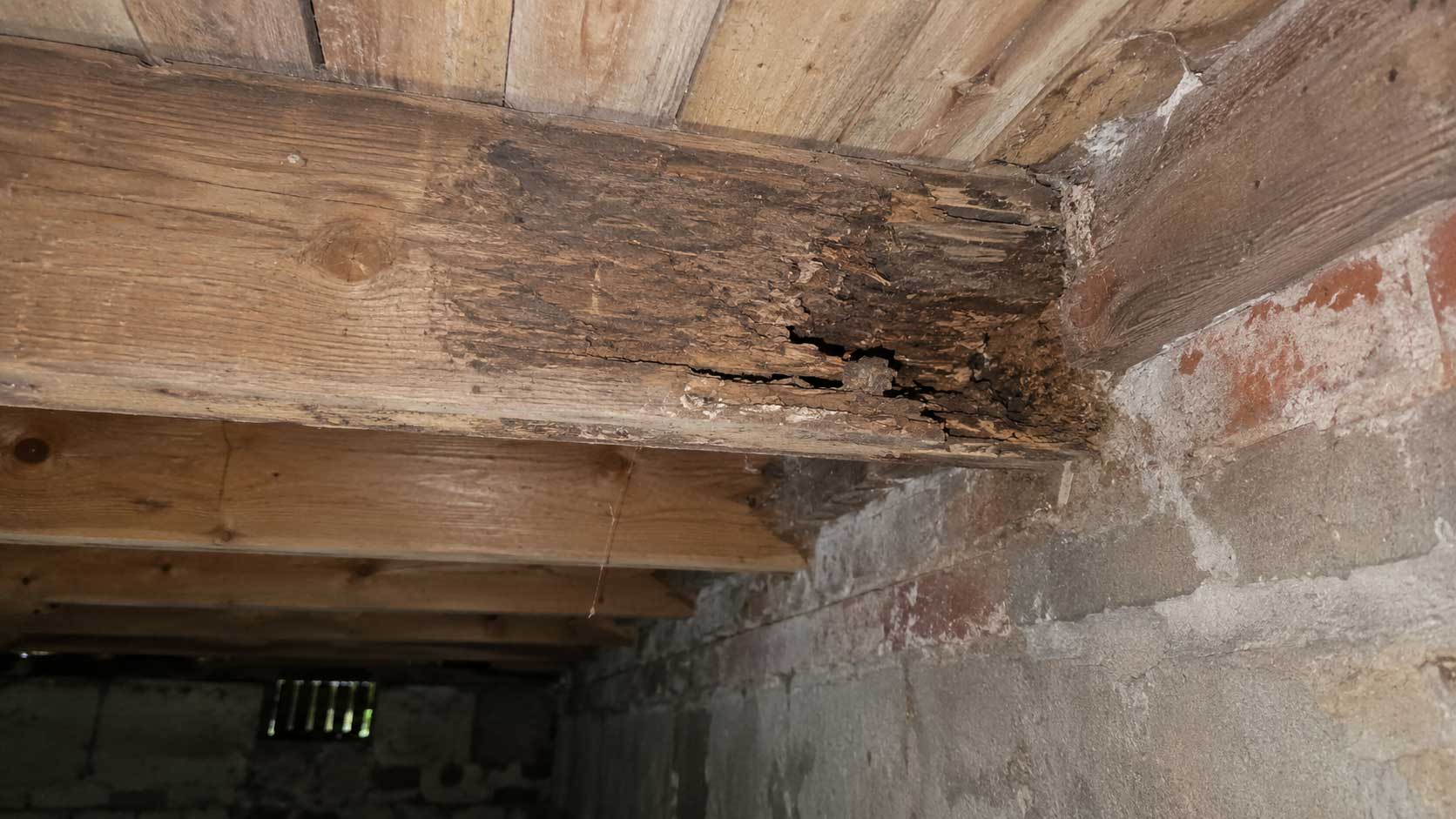
Dark timber is not automatically rotten
Timber can become dark through age, staining, old leaks or surface mould. What matters structurally is whether the wood has lost substance and strength.
A joist that still feels hard and resists careful probing is very different from one whose surface breaks away easily or whose end has lost a large part of its original section.
Look at the shape of the damage
Brown-rot fungi can leave timber with distinctive block-like cracking as the wood shrinks. Other decay may produce softer, fibrous material. Insect damage can leave a network of galleries beneath a surface that initially appears intact.
The pattern can help identify the problem, but it should be combined with moisture readings and an inspection of the surrounding building.
Joist ends can hide serious decay
The end of a floor joist may look reasonable where it emerges from the wall while being badly decayed inside the masonry pocket. Persistent damp at outside walls makes these concealed ends especially important.
Where a floor feels low or springy close to a wall, the support at the joist ends should be considered rather than assuming the floorboards themselves are the problem.
Structural timber needs proportionate investigation
If a rafter, purlin, beam or joist is carrying significant load, the amount of sound timber left matters. Sometimes only a local end section has failed; in other cases decay extends further along the member than the exposed face suggests.
A competent surveyor or structural specialist may need to expose more of the timber before deciding whether it can remain, be strengthened or needs partial replacement.
Useful technical sources
- Historic England — Timber Decay in Buildings and its Treatment
- Historic England — Timber-framed Buildings
These links provide background guidance. A particular building still needs its own inspection.